
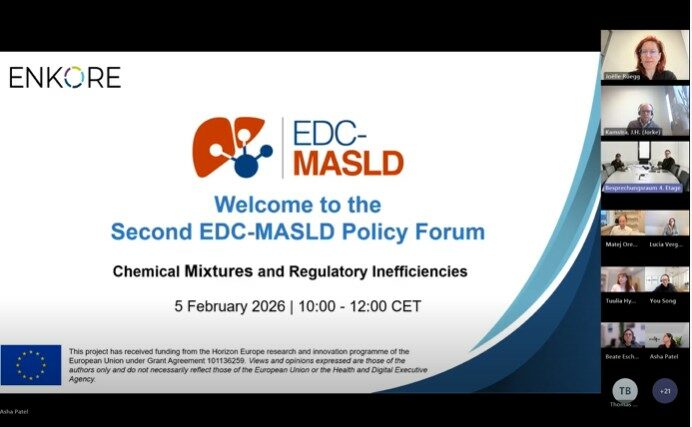
On 5 February 2026, the EDC-MASLD consortium hosted its Second Policy Forum, bringing together researchers and regulatory experts to discuss chemical mixtures and regulatory inefficiencies in chemical risk assessment.
The forum addressed the growing recognition that real-world exposure rarely involves single chemicals. Instead, humans and ecosystems are exposed to complex mixtures of substances whose combined effects may not be captured by traditional substance-by-substance regulatory approaches. Building on recent scientific developments and initiatives such as the EU’s One Substance One Assessment (OSOA) approach, the discussion explored how scientific insights can support more effective assessment and management of chemical mixtures.
The event opened with welcoming remarks from Tuulia Hyötyläinen and Matej Orešič (Örebro University), who introduced the objectives of the forum and highlighted the importance of addressing mixture effects in chemical risk assessment. This was followed by a presentation on the EDC-MASLD mixtures strategy by Jorke Kamstra (Utrecht University) and You Song (Norwegian Institute for Water Research), outlining how the project contributes to advancing mixture research and its relevance for regulatory practice.
The forum continued with an expert panel featuring Prof. Beate Escher (Helmholtz Centre for Environmental Research, UFZ), Prof. Joëlle Rüegg (Uppsala University), Dr. Jacob van Klaveren (RIVM – National Institute for Public Health and the Environment), and Prof. Thomas Backhaus (RWTH Aachen University and the University of Gothenburg).
Together, the speakers brought complementary expertise spanning environmental toxicology, epidemiology, mixture risk assessment, and chemical regulation.
Key Insights from the Expert Presentations
Beate Escher
“Chemical cocktails threaten the environment and human health: It’s all in the mix!”
- Realistic chemical mixtures can cause biological effects even when individual substances are present at concentrations where alone they are not bioactive.
- Effect-based tools are crucial to detect mixture toxicity that is not captured by conventional chemical-by-chemical analysis.
- Current regulatory approaches underestimate risks from complex and unknown mixtures, highlighting a need for more holistic assessment methods.
Joëlle Rüegg:
Mixtures matter: what we can learn from integrating epidemiological and experimental studies”
- Prenatal exposure to mixtures of endocrine disrupting chemicals is associated with adverse neurodevelopmental and health outcomes.
- Combining epidemiological data with experimental testing of realistic reference mixtures (e.g. via hMix and SMACH*) improves risk assessment.
- Additivity is a reasonable regulatory assumption, although mixture effects need to be more systematically investigated to fully understand their complexity.
Jacob van Klaveren:
Mixture Risk Assessment performed using MCRA-software”
- Mixture risk assessment can already be implemented in regulatory contexts using cumulative assessment groups and tools such as MCRA.
- Human biomonitoring data enable assessment of real-life mixture exposures and identification of key risk drivers.
- Improved guidance, transparency, and capacity building are essential to translate mixture risk assessment results into effective regulatory action.
Thomas Backhaus:
The Mixture Allocation Factor (MAF): a tool for the risk management of complex exposures?
- Real-world chemical exposure involves complex mixtures, while current regulatory approaches largely focus on individual substances.
- Combined exposures can lead to risks even when individual substances remain below regulatory thresholds.
- The Mixture Allocation Factor proposes adjusting acceptable exposure levels to ensure that the combined risk from multiple chemicals remains within safe limits.
The Second EDC-MASLD Policy Forum highlighted the importance of continued dialogue between researchers working on chemical mixtures and regulatory risk assessment. By bringing together experts from different disciplines, the forum provided valuable insights into scientific advances, methodological approaches, and regulatory challenges related to mixture toxicity.
The EDC-MASLD Policy Forum organisers thanks all speakers and participants for their valuable contributions and looks forward to continuing these discussions in future policy forums.
