

A new review from the EDC-MASLD Consortium has been published in the Journal of Hepatology. Led by M. Martín-Grau, with contributions from researchers across the consortium, the paper examines how endocrine-disrupting chemicals may contribute to metabolic dysfunction-associated steatotic liver disease, or MASLD.
The paper, “The Hepato-Exposome Axis: How Endocrine Disruptors Hijack Liver Receptors to Drive MASLD,” introduces a receptor-centric framework for understanding how endocrine-disrupting chemicals (EDCs), found in plastics, pesticides, cosmetics, and household products, interfere with the liver’s own metabolic machinery.
These chemicals are found in products such as plastics, pesticides, cosmetics, food packaging and household materials.
What the research shows
Martín-Grau and colleagues reviewed evidence on several major groups of endocrine-disrupting chemicals. These include bisphenols, phthalates, PFAS, organochlorine pesticides, pyrethroids and organophosphate esters.
Across these chemically different substances, the researchers identify a common mechanism called molecular mimicry.
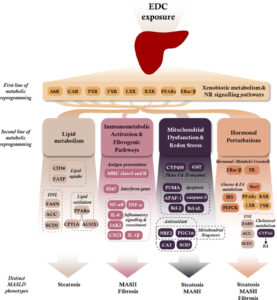
Many endocrine-disrupting chemicals resemble hormones, fatty acids or other signalling molecules produced by the body. This similarity may allow them to bind to the same liver receptors, including PPARs, FXR, PXR, CAR and oestrogen receptors.
By interfering with these receptors, endocrine-disrupting chemicals may alter the pathways that regulate:
- lipid metabolism
- glucose balance
- mitochondrial function
- oxidative stress
- inflammation
- bile acid metabolism
The review describes a recurring pattern across different chemical groups. This includes increased fat synthesis and storage in the liver, reduced mitochondrial function, oxidative stress and low-grade inflammation.
These processes are also involved in the progression of MASLD from steatosis to metabolic dysfunction-associated steatohepatitis, known as MASH, and fibrosis.
Who may be most at risk?
The review also highlights factors that may influence individual susceptibility.
Exposure during pregnancy, infancy and puberty may have a greater impact because these are important periods of hormonal and metabolic development.
The researchers also identify sex differences and pre-existing metabolic conditions as potential factors that may increase vulnerability to endocrine-disrupting chemicals.
Why it matters
Rather than offering a broad overview of environmental hazards, Martín-Grau and colleagues focus on specific biological mechanisms.
The hepato-exposome axis links particular chemical groups with the liver receptors and metabolic pathways they may affect. This provides a useful framework for future research into environmentally influenced liver disease.
The authors also call for stronger research tools, including mixture toxicology, multi-omics exposure profiling and biomarker discovery. These approaches will be important for moving from observed associations towards clearer mechanistic and clinical evidence.
Read the full article
The full paper, including detailed evidence for individual chemicals and the hepato-exposome axis framework, is available open access in the Journal of Hepatology.
👉 Read the full paper: doi.org/10.1016/j.jhep.2026.06.021
Authors: M. Martín-Grau, J.H. Kamstra, T. Hyötyläinen, M. Orešič, Y. Song, N. Veličković, A. Djordjevic, D. Vojnović Milutinović, R.F. Jackson, R. van Vorstenbosch, J. Massart, A. Vidal-Puig and S. Carobbio.
