

Contribution by You Song, Senior Research Scientist at NIVA and EDC-MASLD researcher
EDC-MASLD is pleased to highlight a new publication by You Song in Environmental Science & Technology that explores how innovative New Approach Methodologies (NAMs) can support more efficient and ethical assessment of PFAS chemical risks. This work focuses on emerging alternatives to legacy PFAS substances like PFOA, which are gaining prominence in the environment.
Below, You Song provides an in-depth overview of the study and its significance.
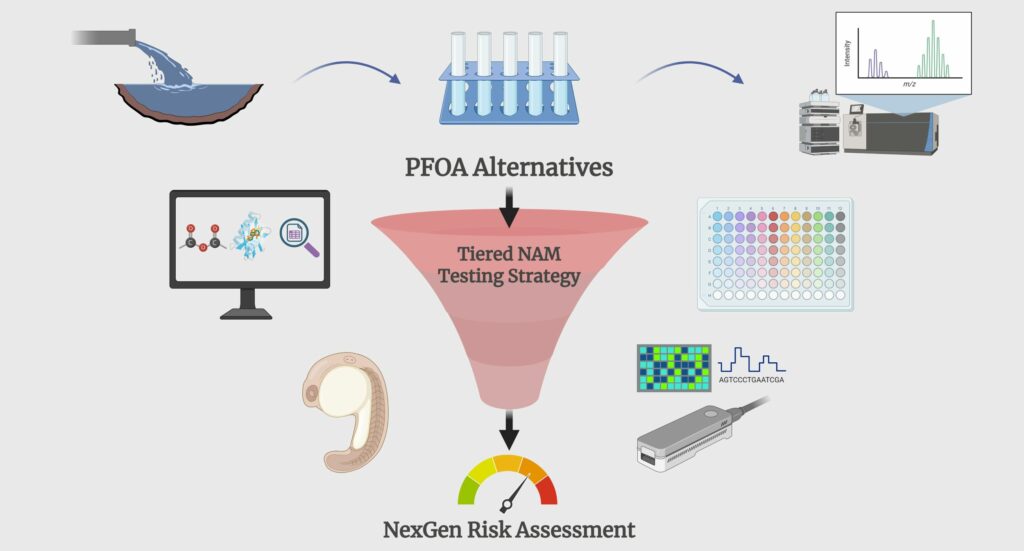 PFAS NAM TOC. Graphical abstract from Song et al., Environmental Science & Technology (2025). DOI: 10.1021/acs.est.5c11122.
Read the Full Publication
Next Generation Risk Assessment of Emerging PFOA Alternatives Using Integrated New Approach Methodologies | Environmental Science & Technology
This research is supported by the Horizon Europe ENKORE Cluster under the EDC-MASLD project (Grant Agreement No 101136259).
PFAS NAM TOC. Graphical abstract from Song et al., Environmental Science & Technology (2025). DOI: 10.1021/acs.est.5c11122.
Read the Full Publication
Next Generation Risk Assessment of Emerging PFOA Alternatives Using Integrated New Approach Methodologies | Environmental Science & Technology
This research is supported by the Horizon Europe ENKORE Cluster under the EDC-MASLD project (Grant Agreement No 101136259).
Key research question: How can we assess the risks of PFAS more efficiently and ethically?
Our new study explores this question using New Approach Methodologies (NAMs) — modern, non animal testing approaches that can make chemical safety assessment faster, more insightful and more humane.
What are PFAS?
Per- and polyfluoroalkyl substances (PFAS) are a large family of synthetic chemicals used in products ranging from non-stick cookware to firefighting foams. Their carbon–fluorine bonds make them incredibly resistant to degradation — which is why they’re often called “forever chemicals.” This persistence, combined with their mobility and potential toxicity, has led to growing concern. Legacy PFAS such as PFOA are being phased out globally, but many alternative PFAS are now entering the market — and we still know relatively little about their environmental and health impacts. Finding efficient, ethical ways to evaluate the risks of these emerging PFAS is therefore a major priority.What are New Approach Methodologies (NAMs)?
New Approach Methodologies (NAMs) refer to a diverse set of tools that help evaluate chemical hazards without relying primarily on traditional animal (mainly) vertebrate testing. They include:- In silico methods such as computational modelling, data mining and predictive (eco)toxicology
- In vitro assays using cultured cells
- High-throughput or high-content screening technologies
- Early life-stage models, which allow in vivo testing while avoiding protected animal use
- OMICS approaches that provide deep molecular insight into biological responses
Our study: Using NAMs to understand the risks of PFAS alternatives
In collaboration with Tsinghua University (China), we applied a tiered and integrative NAM workflow to assess the potential hazards of nine emerging PFOA alternatives. By combining computational tools, cell-based assays, early life-stage models and transcriptomic data, we generated multiple lines of evidence that feed naturally into classical risk assessment. We used these data to derive effect concentrations, benchmark concentrations and transcriptomic points of departure (tPOD), then integrated them with existing toxicological information to build a species sensitivity distribution (SSD). Finally, we compared these hazard thresholds with PFAS levels measured in wastewater and surface waters to understand their real-world relevance.Why it matters
This work shows how NAMs can produce a coherent, science-based picture of PFAS hazards — and provide the threshold values needed to support regulatory decision-making. Importantly, it also highlights how these modern tools can reduce dependence on traditional laboratory animal testing. In short, our study demonstrates how next-generation approaches can help us better understand and manage PFAS, while moving toward more sustainable, ethical and data-driven environmental protection. PFAS NAM TOC. Graphical abstract from Song et al., Environmental Science & Technology (2025). DOI: 10.1021/acs.est.5c11122.
Read the Full Publication
Next Generation Risk Assessment of Emerging PFOA Alternatives Using Integrated New Approach Methodologies | Environmental Science & Technology
This research is supported by the Horizon Europe ENKORE Cluster under the EDC-MASLD project (Grant Agreement No 101136259).
